From the day you realize that you are pregnant, your life changes. Words like cesarean section, tears, epidural, episiotomy, perineal trauma, etc. Before they were not part of your vocabulary and now, you have become an expert on the subject! You may also have heard something related to heperineal massage.
As the weeks passed, in the sweet wait , you start to get used to the idea that nothing will ever be the same again. Your hopes are renewed, your joys multiply and you even fantasize when imagining the baby you are growing inside you.However, although there is no more beautiful wait than pregnancy, not everything is so wonderful. Not only do you harbor tremendous joy. New fears and new worries also arise in your head. Your main concern is that the baby on the way is healthy. You don’t ask for anything more.
But… you also feel a great fear of that great unknown, childbirth . You’ve heard so many things related to this moment that just thinking about it makes you nervous. Throughout the following lines we focus our attention on explaining everything related to perineal massage. Our goal is for you to benefit from this simple technique, to learn when and how to start practicing it, what its benefits are, how to do it correctly,… Are you ready?
What is perineal massage for?
At SingularMom we recommend its practice because of the awareness it gives about the capacity of your pelvic floor. It helps to understand your elastic capacity and the state of your muscles. We recommend that you practice it from week 34 (5 minutes each day) constantly and regularly.Throughout pregnancy and especially in the moment of deliverythe skin of the perineum is subjected to great tension and pressure, which can sometimes cause a tear to occur naturally. Don’t worry, it will only affect the most superficial tissues as long as they don’t do an episiotomy.
Avoiding cutting episiotomy, we will prevent damage to the muscles of your pelvic floor and the tear from affecting deeper tissues and with a more complicated recovery.Important!Perineal massage does not prevent episiotomy.The only way to avoid this is to make it very clear to the staff attending the birth, if possible before everything starts. However, we must know thatBy increasing the flexibility of this muscle it will give us a greater awareness of its elastic capacity..
Pelvic floor awareness and sensations similar to those of childbirth
Can you imagine (especially if you are a first-time “singularmom”) arriving at the moment of delivery having a slight idea of the sensations you are going to encounter? It is not the same to hear it from the mouths of other women as having worked on it yourself with your own body.
One of the great benefits of perineal massage is help you recognize the sensation of pressure and stretch that you will live at the time of giving birth. But not only that, it helps us become more aware of our pelvic floor and reduces labor pain and perineal pain in the postpartum.
With perineal massage we make our perineum more elastic and acquire adequate muscle tone that facilitates the exit of our baby’s head when the time comes. The easier the baby finds his way out, the less damage he will suffer.
How is perineal massage done?
Before starting to do the perineal massage you must extreme hygiene(clean hands and short nails) and prioritize yourcomfort. Furthermore, it is recommended go to the bathroom before to start so that your urethra is relaxed.
You mustchoose the momentwhere you feel comfortable and calm. For example, at the end of the day or after a warm shower (taking advantage of the fact that the muscles are more relaxed) can be two good options.
You may (like the vast majority of women) not be too familiar with this area. That is why, first of all, we want to emphasize how beneficial it is to use amirror that helps you explore and get to know yourself, especially the first few times.
So far so good? Ready?
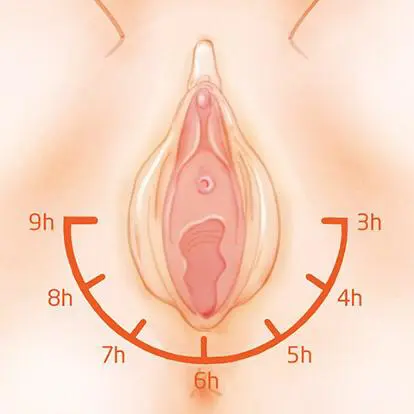
If everything is clear up to this point, let’s start. You must enter your thumbs in the vaginawhile you stand with your legs apart. In a delicate waypushes the perineum down and to both sidesfrom the vagina firmly. Although massages are usually associated with something relaxing, in this case the objective is for you to notice a stinging or burning sensation . Try not to put pressure on the opening of the urethra as this will prevent a possible urinary infection.
Careful! Although it may be annoying at first, we don’t want it to hurt . Simply look for the stinging sensation. If you feel that it is a real torture for you, you don’t need to keep trying.. If you think that the pain is very intense, it would be advisable to do an assessment from the pelvic floor physiotherapy area in case there is any contracture. You can help yourself with a lubricant or natural oil. Of course, always consult with your gynecologist or midwife first.
Perineal massage alone or as a couple?
Due to the increase in volume in your belly, it may be difficult for you to perform perineal massage effectively. That is why one of the most recurring questions is:“Can I do the perineal massage as a couple?”
Of course. You already know that pregnancy also affects your partner. Hence it is It is advisable to try not only to do it alone but also to have their help.. The procedure is the same. The only difference is in the choice of fingers: if your partner does it, it is better to use the middle and index fingers . Sharing such an intimate moment can help not only strengthen the connection between the two but also as an active invitation in the preparation for childbirth. Here you can read more about sexuality in pregnancy.
At SingularMom, we want to help you!
Of course to perform the perineal massage The ideal is to have the help of a physiotherapist specializing in pelvic floor since there are specific cases where it is not recommended (if you have scheduled a Caesarean section, if you suffer vaginal injuries,…). Performing perineal massage is NOT absolutely necessary. However, it is a great option to prepare for the moment of delivery.
At SingularMom we address physical therapy during pregnancy, childbirth and postpartum to prevent and/or recover possible pelvic floor dysfunctions. With our childbirth preparation classes We teach different techniques or methods in a simple and practical way to make this moment as bearable as possible.
We also teach you how to use utensils such as the Winner Flow so you can enjoy a healthy pregnancy, preventing any type of complications.